
MIG/MAG Welding Parameters Calculator
July 23, 2026 at 10:19 am
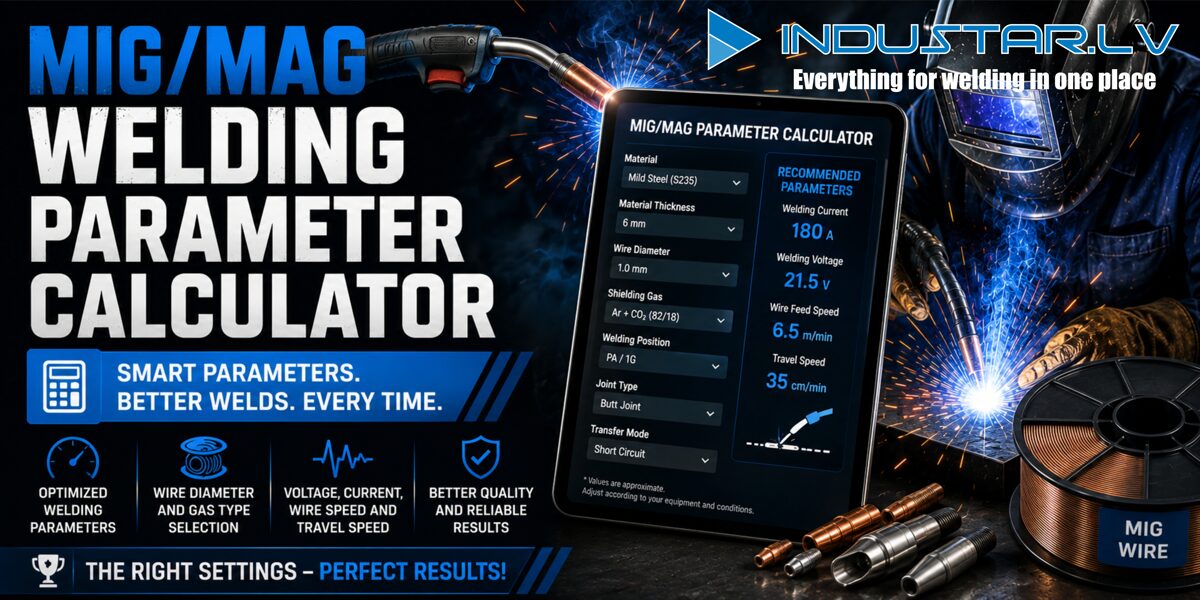
Select the material, thickness, wire, welding mode and working conditions. The calculator will recommend shielding gas, flow rate, wire feed speed, voltage, current, polarity, and starting settings for Pulse and Dual Pulse.
Enter parameters
The results are indicative starting settings. Exact Pulse and Dual Pulse parameters vary depending on the machine, program, wire, gas and torch configuration.
Recommended parameters
Preparing calculation…
Basic parameters
Material / application:
—
Mode:
—
Wire:
—
Suitable applications:
—
Diameter:
—
Polarity:
—
Gas and flow
Shielding gas:
—
Available gas options:
—
Gas flow:
—
Electrical parameters
Voltage:
—
Wire feed speed:
—
Current:
—
Inductance / dynamics:
—
CTWD:
—
Machine output:
—
Machine suitability
Assessment:
—
Practical recommendations
- Recommendations will appear after calculation.
Materials and wires included in the calculator
| Material | Wire selection | Typical gas |
|---|---|---|
| Carbon steel | SG2 / G3Si1 / ER70S-6 or E71T-11 | Ar + CO₂ (18–20%), CO₂, or no gas with E71T-11 |
| Galvanized steel | SG2 or CuSi3 | Ar + CO₂ (18–20%), CO₂, or Ar 100% for CuSi3 |
| Stainless steel | 308LSi, 309LSi, or 316LSi | Argon-based gas for stainless steel |
| Aluminium | AlSi5 / ER4043 or AlMg5 / ER5356 | Ar 100% |
| Cast iron | Ni, NiFe, or stainless steel wire for suitable repairs only | According to the specific wire data sheet |
| Hardfacing | Build-up, 40–50 HRC, 55–65 HRC, or impact-resistant wire | Ar + CO₂ (18–20%), CO₂, or no gas depending on wire type |
Frequently asked questions
Can you weld without shielding gas?
Yes. E71T-11 self-shielded flux-cored wire can be used for carbon steel. No external shielding gas is required and the gas flow is 0 l/min. DC− polarity is commonly used, but always check the specific wire data sheet.
How many litres per minute should be set?
Typical indoor flow is 10–14 l/min. Higher current or air movement may require 14–18 l/min. Excessive flow can create turbulence.
Which gas should be used for carbon steel?
A versatile choice is Ar + CO₂ (18–20%). CO₂ can also be used, but it usually produces more spatter.
Which gas should be used for aluminium?
Ar 100% is most commonly used. An Ar/He mixture may be used for thicker sections.
Do Pulse parameters work for all machines?
No. Exact controls and program structures differ between manufacturers.