
How to choose a welding machine? A complete guide for beginners and professionals
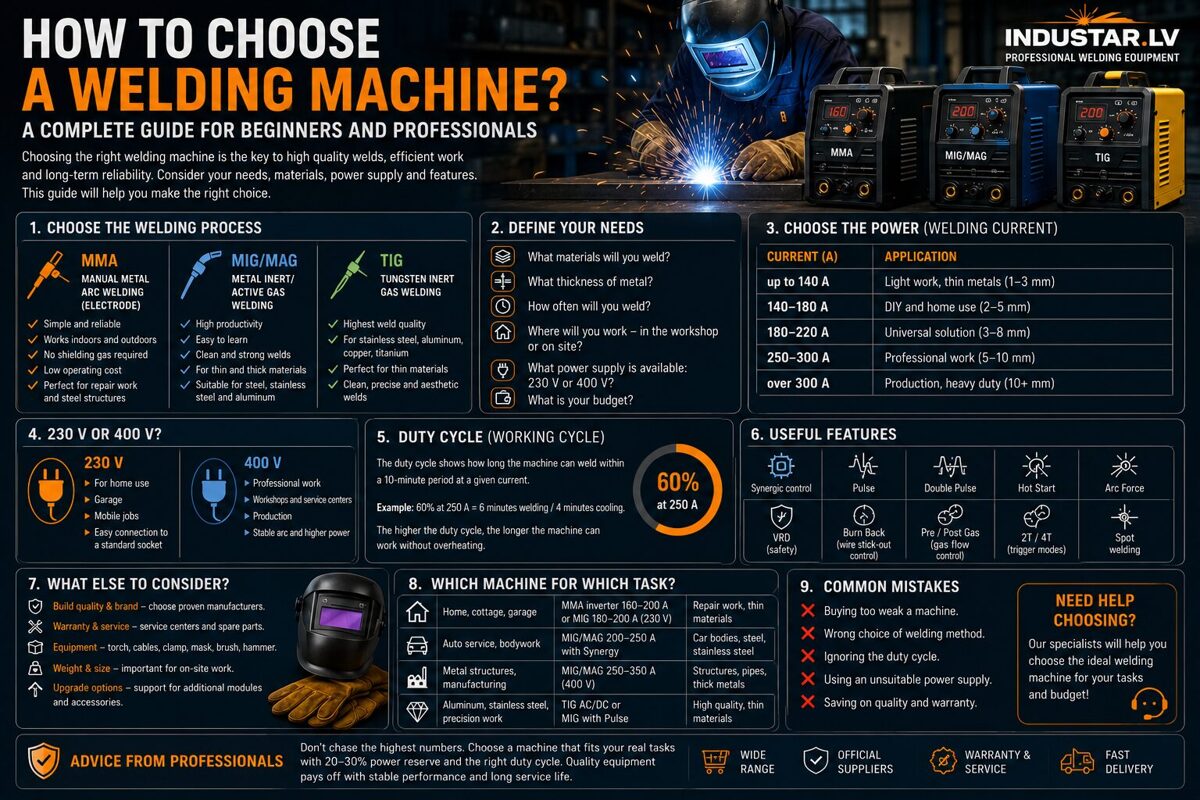
Buying a welding machine is an investment that can last for many years, so it is important to choose equipment that meets your needs. There are hundreds of different models available on the market—from simple MMA inverters to professional MIG/MAG and TIG welding machines with modern features such as Synergy, Pulse, and Double Pulse. If you don’t know where to start, this guide will help you understand the main differences and choose the most suitable welding machine.
First, determine what jobs you will need the welding machine for
Before comparing different models and prices, it is important to understand which jobs will be performed most often. This is exactly what will determine which type of welding machine will be the most suitable.
If you plan to weld a few times a year—repair a trailer, gates, a fence, or agricultural machinery—an expensive industrial machine is not necessary. On the other hand, if welding is daily work in an auto repair shop, metalworking, or manufacturing, it is important to choose a professional machine with a high duty cycle and high reliability.
Think about the following questions:
- How often will you weld?
- What thickness of metal do you plan to weld?
- What materials will be used—carbon steel, stainless steel, or aluminum?
- Will the work take place in a workshop or on-site?
- Is a 230 V or 400 V power supply available?
The more precisely you answer these questions, the easier it will be to find the most suitable welding equipment.
Which welding process should you choose?
One of the most important selection criteria is the type of welding. Each process has its own advantages and applications.
MMA – electrode welding
MMA, or manual arc welding with electrodes, is the simplest and most universal solution. This process is especially popular in households, farms, and repair work.
Advantages of MMA:
- easy to use;
- low purchase price;
- no shielding gas required;
- possible to weld outdoors in windy conditions;
- suitable for welding thicker steel.
If you need a reliable machine for small repair jobs, MMA is often the best choice.
MIG/MAG – the fastest and most universal solution
MIG/MAG welding is the most widely used process in professional metalworking. During welding, wire is fed automatically, which significantly speeds up the work.
Advantages of MIG/MAG:
- high productivity;
- easier to learn than TIG welding;
- neat weld seams;
- possible to weld thin and thick materials;
- suitable for long-term work.
If you plan to regularly weld metal structures, trailers, car bodies, or other products, MIG/MAG will be the most universal solution.
TIG – maximum precision
TIG welding ensures the highest weld quality. It allows you to obtain clean, precise, and aesthetically pleasing seams without spatter.
TIG welding is suitable for:
- stainless steel;
- aluminum;
- thin materials;
- the food industry;
- decorative metal products;
- high-quality structures.
Although TIG welding requires greater skill, the result is significantly higher quality.
What welding current is needed?
The power of a welding machine is specified in amperes (A). The higher the current, the thicker the material that can be welded with quality.
As a guideline:
- up to 140 A – small household repair jobs;
- 180–220 A – a universal solution for home and farm;
- 250–300 A – professional use;
- over 300 A – industry and intensive operation.
It is important to remember that higher power is not always the best choice. For many users, a 200–220 A welding machine is completely sufficient.
230 V or 400 V?
This is one of the most frequently asked questions.
230 V welding machines
Suitable for homes, garages, and mobile work. They can be connected to a standard electrical outlet.
400 V welding machines
Designed for professional workshops and production. They provide higher power, more stable arc burning, and a higher duty cycle.
If welding is your everyday job, a 400 V unit will be a better long-term investment.
What is duty cycle?
Duty cycle shows how long a welding machine can operate continuously at a specified current over a ten-minute period.
Example:
60% at 250 A means the machine can weld for six minutes, after which four minutes are needed for cooling.
The higher the duty cycle, the more suitable the machine is for intensive professional use.
Is it worth buying a synergic welding machine?
If you are buying a MIG/MAG welding machine, synergic control is one of the most useful features.
The Synergy system automatically adjusts voltage and wire feed speed according to the selected material, wire diameter, and welding current. This significantly reduces setup time and helps achieve a high-quality weld even for users with little experience.
What are Pulse and Double Pulse?
Pulse technology provides a more controlled welding arc and lower heat input into the material. It is especially useful for welding aluminum and stainless steel.
Double Pulse additionally creates an even and visually appealing weld bead that often resembles a TIG weld.
If you regularly work with aluminum or high-quality structures, these functions are very valuable.
What additional features are useful?
Modern welding machines offer a range of features that improve work quality and comfort.
The most useful features:
- Synergic control;
- Pulse and Double Pulse;
- Hot Start;
- Arc Force;
- VRD;
- Burn Back;
- Pre Gas and Post Gas adjustment;
- Spot welding;
- 2T/4T mode;
- inductance adjustment;
- Spool Gun support.
When choosing a professional welding machine, pay attention to which of these features you will actually need for your work.
Most common mistakes when choosing a welding machine
Many buyers focus only on price without assessing their needs. As a result, after a short time they have to purchase a more powerful model.
The most common mistakes:
- choosing a machine that is too weak;
- insufficient duty cycle;
- not taking the power supply capacity into account;
- not evaluating the materials to be welded;
- not paying attention to the warranty and availability of spare parts.
A high-quality welding machine is a long-term investment, so it is often more cost-effective to choose a slightly higher-class model.
Conclusion
Choosing the right welding machine starts with assessing your needs. There is no single universal model that suits absolutely everyone. For home users, a quality MMA or synergic MIG/MAG welding machine is often sufficient, while professionals are advised to choose a more powerful unit with a high duty cycle and modern features such as Synergy, Pulse, or Double Pulse.
Before purchasing, compare not only the price and technical specifications, but also the manufacturer’s reputation, warranty terms, service availability, and spare parts supply. A well-chosen welding machine will serve for many years and will allow you to work safely, efficiently, and with professional results.