
Which welding machine should a beginner choose?
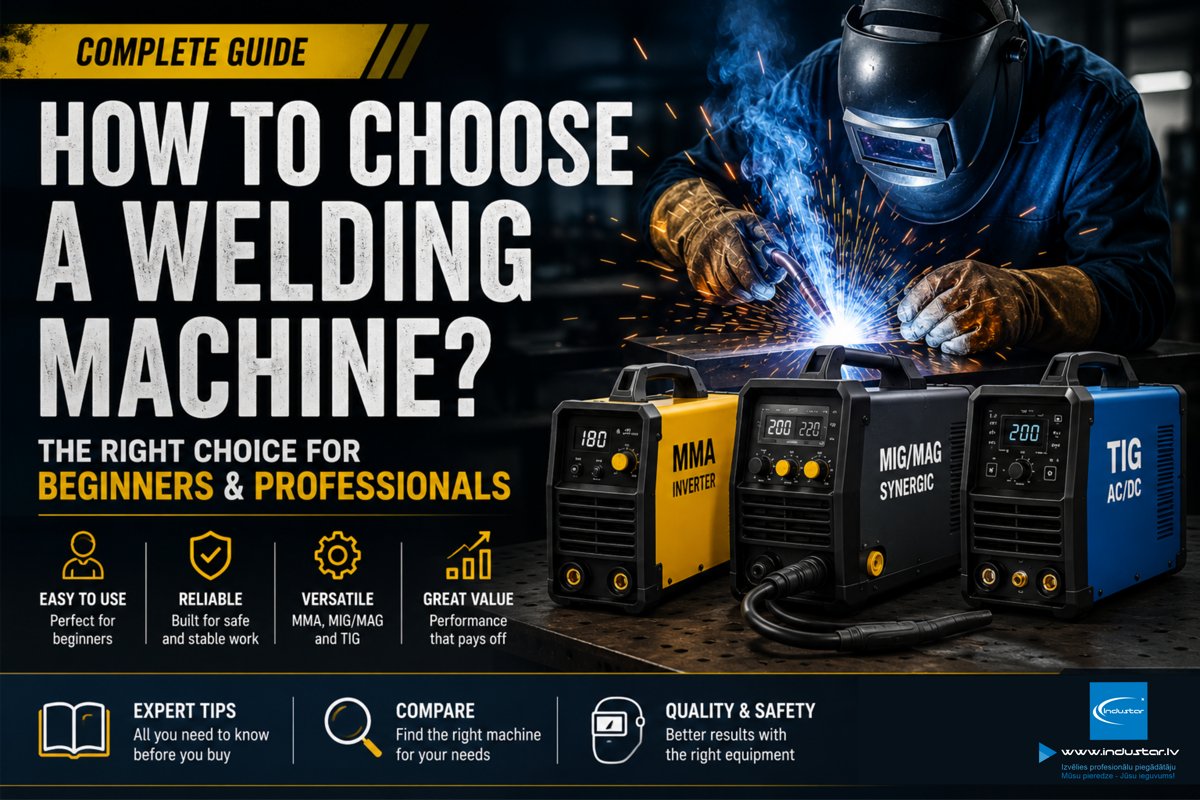
If you’re just starting to learn welding, choosing the right welding machine is one of the most important steps. There are various types of welding machines available on the market – MMA, MIG/MAG and TIG – and each of them is intended for different jobs and levels of user experience. For a beginner, it’s important to choose a machine that is easy to use, reliable, safe, and suitable for the planned work.
In this guide, you’ll learn which welding machine to choose for home use, a garage, or your first professional jobs, and what to pay attention to before buying.
What kind of work are you planning to do?
Before buying a welding machine, think about what you plan to weld most often.
If you need to repair:
trailers;
gates;
fences;
agricultural machinery;
metal structures;
garage equipment;
an excellent choice will be an MMA or MIG/MAG welding machine.
On the other hand, if you plan to weld:
stainless steel;
aluminum;
decorative metal products;
products for the food industry;
thin and visually high-quality structures,
a TIG welding machine will be more suitable, but it should be taken into account that this process requires greater precision and experience.
The more clearly you understand your work tasks, the easier it will be to choose the most suitable welding technology.
What metal do you plan to weld?
Not all welding processes are equally suitable for all materials.
| Material | Recommended process |
|---|---|
| Structural steel | MMA, MIG/MAG |
| Stainless steel | TIG, MIG |
| Aluminum | TIG AC/DC or MIG with appropriate equipment |
| Galvanized steel | MIG/MAG or TIG |
| Cast iron | MMA with special electrodes |
If you will mostly weld mild steel, a high-quality MMA or MIG/MAG machine will be completely sufficient.
MMA – the simplest choice for beginners
MMA, or stick welding machines, are among the most popular among beginners. They are compact, reliable, and do not require shielding gas.
Main advantages:
easy to use;
lower initial costs;
suitable for outdoor work;
works well even on slightly rusty metal;
easy to transport;
relatively low operating costs.
If welding will be a hobby or small repair jobs at home, a quality MMA inverter is often the most cost-effective solution.
MIG/MAG – easier to achieve beautiful welds
Many specialists believe that MIG/MAG welding for beginners is even simpler than MMA. The machine feeds the welding wire automatically, so it is easier to maintain an even weld bead.
A MIG/MAG machine is suitable for:
car body repairs;
welding thin sheet metal;
manufacturing metal structures;
long continuous weld seams;
regular welding work in a workshop.
If possible, choose a synergic (Synergic) MIG welding machine, as it automatically adjusts the main welding parameters and significantly makes the work easier for beginners.
TIG – when maximum quality matters
TIG welding makes it possible to obtain very clean and precise weld seams, but it is technically more complex. The welder must simultaneously control the torch, the filler material, and the welding arc.
TIG welding is recommended if:
you already have prior welding experience;
you need to weld aluminum or stainless steel;
high weld quality is important;
an aesthetic final result is required.
For a complete beginner, TIG is usually not the first recommended option.
What power should you choose?
For most home users, a 180–220 A welding machine is completely sufficient.
A machine with this power allows you to weld:
metal profiles;
fences;
trailers;
garage structures;
various household metal parts;
metal pipes.
If in the future you plan to weld thicker materials more often or work professionally, it is worth considering a 250–300 A class welding machine.
230 V or 400 V?
For most beginners, the most suitable solution is a 230 V welding machine, because it can be connected to a standard household power supply.
Meanwhile, 400 V welding machines are intended for professional workshops and manufacturing companies where higher power, a longer duty cycle, and continuous operation are required.
If you are not sure, in most cases 230 V will be a completely sufficient solution.
How important is the duty cycle (Duty Cycle)?
Many beginners do not pay attention to the duty cycle, but it is one of the most important parameters.
The duty cycle shows how long the welding machine can operate continuously at a certain current.
For example:
60% at 200 A means that within 10 minutes you can weld for about 6 minutes, after which about 4 minutes are needed for cooling.
For home needs, a 30–40% duty cycle is usually completely sufficient, while for professional use it is recommended to choose models with a 60% or higher duty cycle.
What features are useful for a beginner?
Modern welding machines are equipped with features that significantly make the work easier.
It is recommended to choose a model with:
Synergic control;
Hot Start for easier arc ignition;
Arc Force for more stable welding;
Anti Stick, which reduces electrode sticking;
VRD function for safer work;
2T/4T mode for longer weld seams;
PFC technology for more stable operation in case of power supply fluctuations.
These features help you learn welding faster and reduce the likelihood of mistakes.
What accessories will be needed?
In addition to the welding machine, quality accessories are also required.
For MMA welding:
electrodes;
welding helmet;
welding gloves;
wire brush;
welder’s chipping hammer.
For MIG/MAG welding:
shielding gas cylinder;
pressure regulator;
welding wire;
contact tips;
torch spare parts.
For TIG welding:
argon;
tungsten electrodes;
filler rod;
ceramic nozzles;
collets and holders.
Quality accessories significantly affect weld quality and working comfort.
Which welding helmet should you choose?
Safety always comes first.
Beginners are recommended to choose an auto-darkening welding helmet with:
DIN 9–13 shading range;
True Color technology;
adjustable sensitivity;
adjustable delay time;
a comfortable headgear.
A good welding helmet significantly reduces eye fatigue and makes the work much more comfortable.
How much does a welding machine cost?
The price of a welding machine depends on the technology, power, functionality, and manufacturer.
Approximate price categories:
MMA inverters – from €120 to €350;
MIG/MAG machines – from €350 to €1500;
TIG DC machines – from €400 to €1800;
TIG AC/DC machines – from €900 to €4000.
When choosing a welding machine, you should not be guided only by price. The availability of spare parts, warranty service, and technical support are also important.
Most common mistakes
When choosing their first welding machine, beginners often make several mistakes.
The most common are:
choosing the cheapest model instead of the most suitable one;
not paying attention to the duty cycle;
not considering the availability of service and spare parts;
buying equipment that is too complex;
not using a high-quality welding mask;
choosing the wrong electrodes or wire;
not following safety requirements.
Choosing the right equipment will help you avoid many problems and will significantly make learning welding easier.
Conclusion
If you are looking for your first welding machine, the choice mainly depends on the work you plan to do.
MMA is an excellent choice for home repair work—easy to use, lower costs, and the ability to work outdoors as well.
MIG/MAG is ideal for those who want to quickly learn how to make high-quality weld seams and plan to weld regularly.
TIG is suitable for precision work, welding stainless steel and aluminum, but it requires more experience and skills.
If you are not sure which welding machine to choose, consult specialists. A properly selected machine will allow you to learn welding much faster, work more safely, and achieve a high-quality result from your very first welds.